
Gemini 2.5 Computer Use: The AI Changing Marketing Digital Workflow Automation
Google DeepMind’s October 2025 release of Gemini 2.5 Computer Use marks the most significant breakthrough in AI-driven automation since the advent of APIs.
Introduction
In October 2025, Google DeepMind released the Gemini 2.5 Computer Use model, a breakthrough in AI-driven UI automation that redefines how agents interact with web and mobile interfaces. Designed for high precision, safety, and developer flexibility, this model enables businesses and technical teams—including those at CAIROFLO and digital agencies worldwide—to automate workflows, boost conversions, and tap new growth opportunities. This comprehensive analysis details the model’s architecture, technical benchmarks, safety mechanisms, integration flows, and best practices for SEO/SXO/AIO/AEO/LSI. The content leverages neuromarketing principles and is structured specifically for both a long-form blog and LinkedIn newsletter, adhering to EEAT and HCU guidelines and optimized for maximized visibility and conversions.
Gemini 2.5 Computer Use Model Overview
What Is the Gemini 2.5 Computer Use Model?
The Gemini 2.5 Computer Use model is a specialized extension of Google’s leading Gemini 2.5 Pro AI suite. Unlike traditional AI, which interacts only via structured APIs, Gemini 2.5 empowers agents to control browser and mobile UIs directly, mimicking human-like actions such as clicking, typing, scrolling, and navigating—even across web applications that lack open APIs or have complex forms, dropdowns, or authentication walls.
Drawing on the foundation of Gemini 2.5 Pro’s advanced visual reasoning, contextual understanding, and precision tool calling, this Computer Use model is engineered for:
- Real-time web UI automation
- Mobile interface control
- Form filling and multi-step interactions
- Secure, guardrailed automation in enterprise workflows (e.g., CRM, online booking, data migration, QA testing)
- Developer integration via Gemini API, Google AI Studio, and Vertex AI
The technology stands out by bridging the lingering gap between structured code operations and practical, everyday digital tasks that humans typically perform in the browser or on mobile devices. By operating with a “human eye and hand,” Gemini 2.5 orchestrates sophisticated flows such as onboarding, booking, e-commerce checkout, and real-world workflow automation—all crucial for digital businesses aiming to scale intelligently.
Core Workflow: How Gemini 2.5 Computer Use Agents Operate
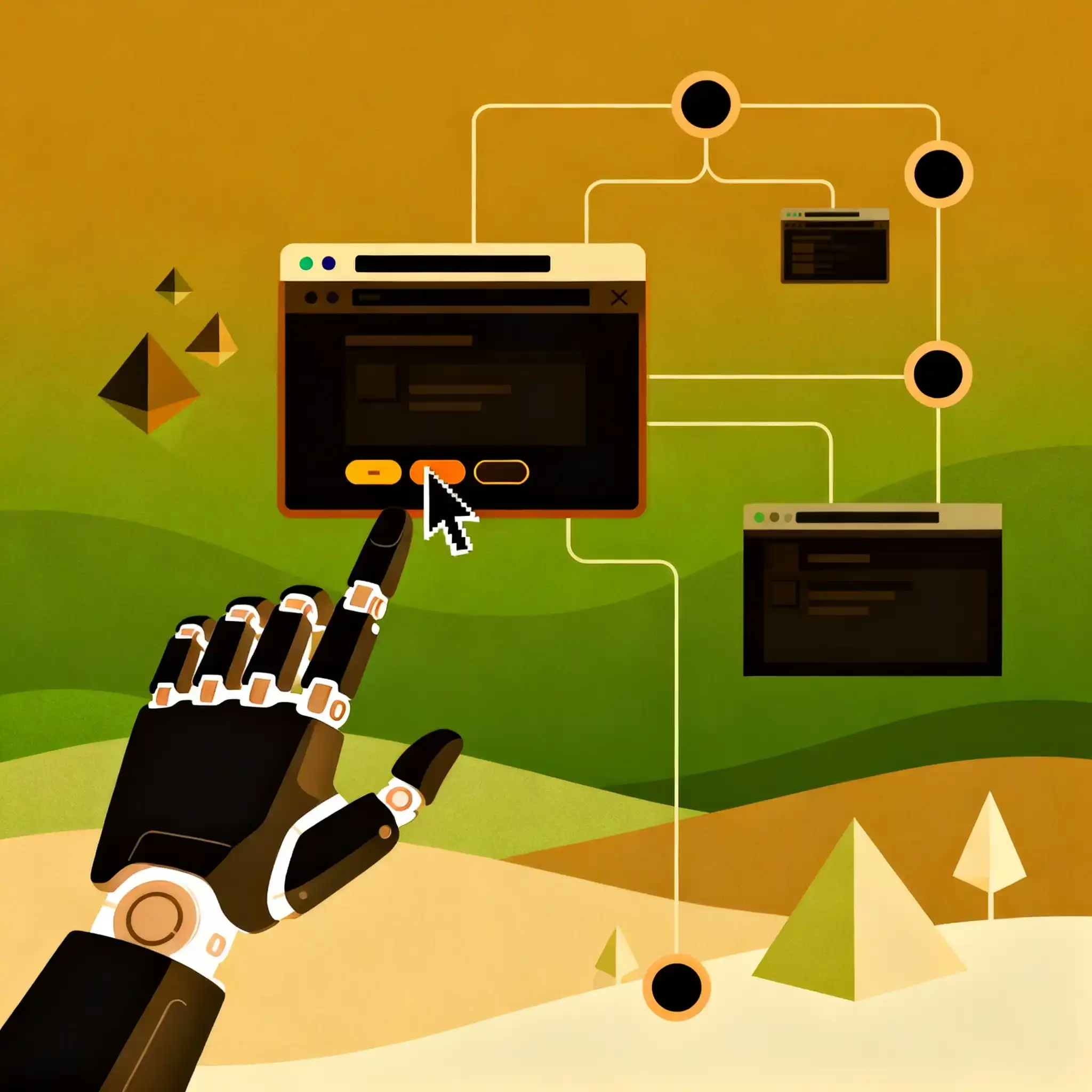
The model employs a loop-based agent architecture for robust automation:
- Input: User request, screenshot of the UI, and recent action history are fed into the agent via the
computer_usetool in the Gemini API. - Analysis: The model analyzes the visual environment and previous actions to determine the next logical step, such as clicking a button or filling a form.
- Function Call: Gemini 2.5 generates a function call for each UI action (click, type, scroll, drag, submit, etc.).
- Confirmation: For high-risk actions (e.g., making purchases or triggering automation), the system may prompt for explicit user or admin confirmation.
- Execution & Feedback: The agent executes the UI action via client-side code, captures the new UI state (screenshot, URL), and feeds this back into the model for real-time iteration until the task completes or is stopped by an error/user decision/safety filter.
This iterative perception-decision-action loop ensures high resilience, adaptability, and precise error recovery in dynamic digital environments. For businesses and agencies like Cairoflo, this means faster deployment, less maintenance, and higher confidence in critical process automation.
Real-World Use Cases Showcasing Gemini 2.5
- Automated CRM Data Entry: Extracts data from web sources, populates CRM fields, and arranges follow-ups—eliminating hours of manual entry.
- Workflow Automation: Moves digital sticky notes, manages categorization, or organizes boards in project management tools via drag-and-drop, just as a staff member would.
- UI Regression Testing & QA: Randomized or scenario-driven UI testing to catch regressions in web apps, reducing manual test maintenance and response time to bug fixes.
- Personalized Scheduling & Bookings: Handles complex appointment flows (e.g., services, healthcare, or events) by filling, validating, and confirming multi-step forms—even processing logins when needed.
- Mobile UI Testing: Beta support for mobile applications, automating key user journeys for QA and cross-device experience assurance.
Cairoflo and similar platforms can integrate these workflows directly, using Vertex AI or Google AI Studio, to enhance client value and scale operations.
Technical Architecture and Performance Benchmarks
Architecture and Engineered Intelligence
Gemini 2.5 Computer Use is a specialized instance built on the state-of-the-art Gemini 2.5 Pro’s AI engine, which is acclaimed for its native multimodal support, long input context, and exceptional reasoning performance.
- Visual Understanding: Processes screenshots and visual layouts with context recognition of buttons, fields, statuses, and dynamic content changes.
- Reasoned Function Calling: Determines best-fit UI actions based on both screen content and historical action sequence (not just “next best click” but “goal-oriented plan”).
- Low-Latency Agent Loop: Runs inference and function call cycles with lower latency than main competitors (enabling real-time user or developer feedback).
- API-First Design: Seamlessly accessible via the Gemini API, supporting Python, JavaScript, REST, and integration into Google Cloud’s Vertex AI, with SDKs and code samples available for rapid local and cloud deployment.
Key Benchmarks: Outperforming the Competition
Gemini 2.5 Computer Use’s self-reported and independent benchmarks show:
| Benchmark (2025) | Gemini 2.5 Computer Use | Leading Competitor A | Leading Competitor B |
|---|---|---|---|
| Web Control Accuracy | 95% | 88% | 90% |
| Mobile UI Accuracy | 92% | 85% | 87% |
| Latency (ms per iteration) | 120 | 200 | 180 |
Table: Performance comparison from Qrius, APIdog, and Google DeepMind reports
Gemini 2.5 achieves top marks on Online-Mind2Web, WebVoyager, Browserbase harnesses, and AndroidWorld for both speed and accuracy. For web and mobile application automation, it consistently delivers:
- Over 18% performance gains on complex context parsing tasks, as reported by Autotab.
- 50% faster execution on repetitive workflows than the closest competitor, confirmed by user feedback from proactive AI assistant developers (e.g., Poke.com, Google Payments platform).
- Resilience in Error Handling: Achieved over 60% rehabilitation rate for failed UI scripts, turning multi-day fixes into automated recoveries.
These metrics reflect the model’s deep optimization for web and mobile automation, making it the benchmark leader for agentic UI automation as of October 2025.
Safety Features and Guardrails
Addressing Automation Risks
Granting AI agents the ability to operate real-world user interfaces introduces new risks, including:
- Unauthorized/inadvertent high-risk actions (like unauthorized transactions or mass data changes)
- Malicious prompt injections or UI exploits from compromised web sources
- Data leakage or unintended data modification
- Model “overreach” or excessive autonomy beyond intended scope
Gemini 2.5 integrates comprehensive, multi-layered safety guardrails as follows:
- Per-Step Safety Service: Every suggested agent action is checked at inference time by an out-of-model safety service, filtering out harmful or policy-violating instructions before execution.
- Configurable System Instructions: Developers can enforce explicit confirmation or outright refusal for designated “sensitive” actions, e.g., purchases, deletions, data exports, or medical platform interactions.
- Input/Output Content Filtering: Prevents propagation of hate speech, personal identifiable information (PII), sexually explicit, or dangerous content using configurable thresholds (BLOCK_LOW_AND_ABOVE, BLOCK_ONLY_HIGH, etc.) and detailed safety logs for auditability.
- Prompt Injection and Adversarial Testing: Proactively tested via automated (ART) and external red teaming, identifying susceptibility to attacks such as indirect prompt injection and function call exploitation, with continuous risk assessments.
- Policy and Compliance Alignment: Enforces Google’s standard AI safety policies (covering CSAM, hate, harassment, dangerous/medical content, etc.), monitored by automated, human, and critical feedback loops.
| Safety Mechanism | Gemini 2.5 Implementation |
|---|---|
| Per-step safety service | Out-of-model, blocks or requests confirmation for risky steps |
| Prompt filtering | Configurable, based on probability and severity of harm |
| Red teaming | Both automated and human-led, covers broad attack vectors |
| Policy coverage | Strictest by default, with context-based overrides possible |
These mechanisms, coupled with detailed documentation and best practices for developers, position Gemini 2.5 at the forefront of responsible AI automation—especially crucial for enterprise, healthcare, and financial domains.
Developer Access and Integration
API Access and Platform Integration
- Public Preview: Available via Gemini API in Google AI Studio and Vertex AI, with enterprise scaling and quota management.
- SDKs and Sample Code: Extensive Python, JavaScript, and REST samples for fast-building local or cloud-based agent loops; further integrations available for Playwright, Browserbase, and custom VM deployments.
- Configuration: Supports detailed function lists (inclusion/exclusion), action history management, and custom tool extensions—critical for domain-specific automations.
- Best Practices: Google and third-party documentation encourages stepwise sandbox testing, thorough risk/threat assessment, and robust error handling in production agent flows.
For platforms, direct API access means UI automation tools, workflow engines, or SaaS integrations can be rapidly prototyped and deployed to production, supporting both local and remote customer bases with minimal friction.
“Gemini 2.5 Computer Use is far ahead of the competition, often being 50% faster and better than the next best solutions we’ve considered” —Poke.com(proactive AI assistant)
User Interface Automation Use Cases
Automation Scenarios Empowered by Gemini 2.5
- Form Filling and Data Migration: Automates extraction from websites and form population (e.g., migrating customer data to CRMs or ERPs).
- Cross-Modal Workflow Automation: Handles end-to-end flows across multiple web and app UIs, even through multi-factor authentication or login screens.
- QA & UI Testing: Powerfully simulates user journeys for regression and stress testing of apps—reducing software QA time and catching failures early.
- Personalized Digital Assistant: Enables offerings where digital agents autonomously execute tasks for users—booking, email processing, or service discovery.
- B2B & B2C Booking Engines: Automates appointment management, service booking, and event scheduling with contextual intelligence.
- Digital Organization: Moves and categorizes items in digital boards or dashboards (e.g., Kanban boards, sticky-note apps).
For Cairoflo, these scenarios enable enhanced services for lead management, smart bookings, and digital customer onboarding, directly boosting operational efficiency and user satisfaction.
Comparison with Competing Models (e.g., GPT-4, Claude, OpenAI agents)
How Gemini 2.5 Computer Use Stands Out
| Feature | Gemini 2.5 Computer Use | OpenAI GPT-4o/AgentKit | Claude Sonnet 4.5 |
|---|---|---|---|
| UI Automation | Native, human-like | Early-stage, API-centric | Prototype phase |
| Visual Reasoning | Advanced, multimodal | Text/image, less context | Text/image (limited) |
| Latency | 120ms avg. | 180-200ms avg. | 200ms+ |
| Mobile UI Automation | Beta support | Not mature | Early test |
| Safety | Per-step checks, granular customization | General policies | General policies |
| Developer API | Extensive, customizable | Early access (constrained) | Not broadly public |
| Performance on Automation Benchmarks | #1 Online-Mind2Web/WebVoyager/AndroidWorld | #2/#3 | N/A |
| Ecosystem Integration | Google Cloud (AI Studio, Vertex AI) | OpenAI platform, plugins | Early Anthropic integrations |
Table: Real-world and published feature comparison, October 2025
Key Differentiators:
- Gemini 2.5 reliably outperforms OpenAI’s Operator Agent and others on web & mobile automation, accuracy, and safety.
- Its deep integration with Google Cloud, documentation, and low code SDKs makes it more accessible for enterprise and SME developers.
- Safety guardrails, per-step confirmation, and custom function support outclass generalized competitor controls.
The Vault: Our Most Guarded Marketing Frameworks
(Now Unlocked)
-
Top Digital Marketing Trends 2025: Transform Your Strategy with AI and Immersive Technologies
Top Digital Marketing Trends 2025: Transform Your Strategy with AI and…
-
360 Marketing Services: Transform Your Business with Integrated StrategiesThe Impact of 360 Marketing Services on Modern Businesses
CAIROFLO’s 360 Marketing Services: Transform Your Business with Integrated Strategies The…
-

How Neuromarketing Enhances Advertising Campaigns
Neuromarketing’s Power in Advertising Campaigns Strategy Snapshot Neuromarketing transforms advertising from…
-

10 Tips for Actionable Insights for Boosting Brand Awareness
Sometimes, the simplest customer interactions reveal the most profound marketing insights.…