
AGENTIC AI IN 2026: 5 Roles will End or Make Your Career
In 2024, the job market screamed “prompt engineer.” In 2026, that role is already commoditized. But something bigger just happened: organizations discovered they don’t need more individual AI tools; they need architects who orchestrate systems of agents working together.
That shift isn’t subtle. It’s structural. And it’s about to reshape who gets hired, who gets promoted, and who becomes obsolete.
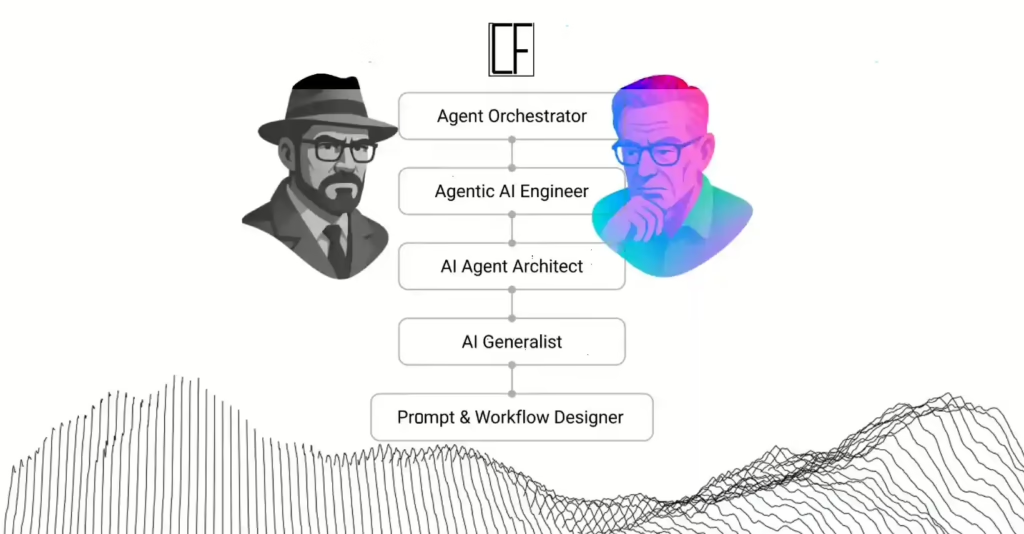
Role #1: The Agent Orchestrator (The New Middle Manager)
What they do: Think of an orchestrator as a manager, except instead of managing people, they’re managing a synthetic workforce. They design which agents connect to what systems, set boundaries (guardrails), monitor performance, and decide when an agent needs human intervention.
Why it matters: 82% of executives expect AI agents in their workforce within 18 months. But only 23% feel confident integrating them. That gap is where the Orchestrator lives.
Pros:
- Zero coding required (you manage, not code)
- Strategic, high-visibility work
- First roles to reach six-figure compensation
- Direct path to VP-level roles
Cons:
- Requires business acumen + technical fluency (hybrid skillset is rare)
- Accountable for agent failures (high pressure)
- Job didn’t exist 18 months ago (no clear career ladder yet)
- Salary competition is fierce because it’s still scarce
Best niches for Orchestrators:
- Financial Services – Agents managing loan approvals, risk assessments, compliance
- Customer Service – Multi-agent triage systems routing tickets intelligently
- Operations – Agents automating supply chain decisions, inventory planning
- Healthcare – Agents coordinating patient data workflows, billing automation
Case Study #1: JPMorgan Chase’s Orchestrated Loan Processing
JPMorgan implemented agent orchestrators to oversee three specialized agents: one for document intake, one for risk analysis, one for compliance checks. A single orchestrator managed these agents, setting rules like “You can approve loans under 500k without escalation, but above that requires human sign-off.” Result: Loans processed 40% faster, with zero compliance violations. The orchestrator role started at $180k and expanded into a team of 8 within a year.
Career trajectory: Orchestrator → Senior Orchestrator → Director of Agent Operations → VP of Intelligent Automation
Case Study #2: Retailer’s Inventory Orchestration Failure (and Recovery)
A regional retail chain deployed agent orchestrators without proper governance guardrails. Agents made autonomous inventory decisions that broke supply chain partnerships. The orchestrators had set permissions too loosely. After a crisis, they rebuilt with strict “human-in-the-loop” rules at every critical decision. The recovered system reduced markdown losses by $1.2M annually.
Learning: Orchestrators who understand operational risk earn more and advance faster.
Case Study #3: Accenture’s Client-Facing Orchestrator Model
Accenture hired 50+ agent orchestrators specifically to help enterprise clients integrate agents. These consultants combine technical understanding with change management. They earn $150k–$210k and often move into partner tracks. Some later start consulting firms.
Career trajectory: Internal Orchestrator → Client-facing Orchestrator → Principal Consultant → Founding Partner
Career Verdict (2026–2028): TOP TIER. Highest demand, highest pay, clearest path to leadership.
Role #2: Agentic AI Engineer (The Builder)
What they do: Write the actual agent code. They design agents that can plan multi-step tasks, access tools (APIs, databases), reason about problems, and execute autonomously. Think of them as the architects of the agents that orchestrators will later manage.
Why it matters: Every agent that an orchestrator manages requires an engineer who built it. No engineers = no agents = no orchestrators. It’s the technical foundation.
Pros:
- High salaries ($140k–$220k base)
- Abundant job openings (77% of organizations are hiring, supply is low)
- Remote work is common
- Skills transfer across industries
Cons:
- Requires deep Python, ML, and system architecture knowledge
- Steep learning curve (not for career switchers without tech background)
- Burning out as companies scale fast
- Job market may saturate in 3–5 years as the field matures
Best niches for Agentic AI Engineers:
- SaaS/AI Platforms – Building agents as products (highest pay: $200k+)
- Enterprise Software – Custom agent solutions for large orgs
- Healthcare Tech – Agents for diagnostic assistance, treatment planning
- Fintech – Agents for trading, fraud detection, underwriting
- E-commerce – Agents for demand forecasting, dynamic pricing
Case Study #1: OpenAI/Anthropic’s Internal Agent Team
Agentic AI engineers at frontier labs are building agents that reason over code, research papers, and system logs. These engineers command $250k–$400k total compensation (base + equity) and have first access to cutting-edge models. Some published papers, others moved to found AI safety companies.
Career trajectory: Engineer → Senior Engineer → Staff Engineer → Founding Engineer of spinout → AI Lab Director
Case Study #2: Stripe’s Fraud Detection Agent Team
Stripe deployed agentic engineers to build agents that detect fraud patterns in real-time. Instead of static rules, agents reason through transaction data. One engineer’s contribution saved the company $50M in prevented losses. That engineer was promoted to lead an 8-person team within 18 months and is now being recruited by VC firms as a technical advisor.
Career trajectory: Mid-level Engineer → Lead Engineer → Founding Technical Advisor → VC-backed Startup Founder
Case Study #3: Healthcare Startup’s Agent That Failed, Then Succeeded
A Series B healthcare startup hired agentic engineers to build agents for diagnostic suggestions. First version hallucinated medical advice. The engineers iterated 47 times, added verification layers, implemented Monte Carlo reasoning. By month 9, the agent achieved 94% accuracy on test cases. Those engineers became the technical founders of a $40M Series B round.
Learning: The engineers who fix broken agents learn more than those who build perfect ones first time.
Career Verdict (2026–2028): TOP TIER. But only if you’re willing to keep learning. The technology moves fast. Engineers who adopt new frameworks quickly stay valuable. Those who coast on old knowledge become commodities within 18 months.
Role #3: AI Agent Architect (The Designer)
What they do: Different from an engineer (who codes). Architects design what agents should do, how they should interact with other systems, and what guardrails they need. They bridge business requirements and technical implementation.
Why it matters: A beautifully coded agent that solves the wrong problem is worthless. Architects prevent that.
Pros:
- Leadership path is faster than pure engineering
- Business-facing work (higher visibility with executives)
- Salary competitive with engineers ($140k–$180k)
- Strategic influence on product direction
Cons:
- Requires both technical and business acumen (hard to find)
- Slower to see tangible results (design work is upstream)
- Often caught between engineering and product teams (political friction)
- If agents fail, architects sometimes blamed over engineers
Best niches for AI Agent Architects:
- Enterprise AI Solutions – Designing agent ecosystems for large orgs
- Healthcare – Architecting clinical decision support agents
- Financial Services – Agent systems for risk, compliance, trading
- Supply Chain – Multi-agent logistics networks
- Marketing/Sales Automation – Agent-driven customer journey orchestration
Case Study #1: Microsoft Copilot Architect Team
Microsoft’s architecture team designed how Copilot agents should decompose user requests into sub-tasks, access knowledge, and synthesize responses. The lead architect’s framework became the foundational pattern Microsoft pushed across Office, Teams, and Dynamics. That architect was promoted to Distinguished Engineer and now advises the CEO on AI strategy.
Career trajectory: Architect → Principal Architect → Distinguished Engineer → VP of Product Strategy
Case Study #2: Deloitte’s Agent Architecture for a Fortune 500 Bank
Deloitte’s architects designed a multi-agent system for a large bank: agents for compliance, agents for customer service triage, agents for analytics. The architecture won a $50M multi-year contract. The lead architect became a Principal and is now building Deloitte’s entire Agentic AI consulting practice.
Career trajectory: Architect → Principal Consultant → Practice Leader → Partner
Case Study #3: Healthcare Startup That Built Agents Wrong (Then Right)
A health-tech startup’s first architect designed agents that operated independently, which created liability nightmares (agents making clinical recommendations without human oversight). They redesigned with “human-in-the-loop” logic at every critical decision. The revised architecture became their IP moat. Two of the architects stayed and built a $15M Series A.
Learning: Architects who understand governance frameworks, compliance, and organizational risk become invaluable.
Career Verdict (2026–2028): TOP TIER. If you combine architecture skills with regulatory domain knowledge (healthcare, fintech, government), you’re essentially unhireable; in a good way. Companies will compete for you.
Role #4: AI Generalist (The Translator, Not the Builder)
What they do: Unlike specialists, AI Generalists work across multiple business functions using AI to solve diverse problems. They’re not coding agents or designing systems. Instead, they’re asking “Where can AI create the most value?” across marketing, HR, operations, and strategy. They’re bridges between technical teams and business leaders.
Why it matters: Every department now needs someone who understands AI, but most orgs don’t have time to hire 20 specialists. Generalists fill that gap and move faster.
Pros:
- No deep coding required (lower barrier to entry)
- Fastest path for non-technical people into AI
- Very flexible across industries
- Leadership roles come faster (generalists often become managers quickly)
Cons:
- Lower salaries than specialists ($100k–$140k vs. $140k–$220k)
- Jack-of-all-trades, master-of-none problem (you go deep, you become a specialist)
- Harder to prove ROI of your work
- Vulnerable to automation (as AI tools get better, generalist work becomes commoditized)
Best niches for AI Generalists:
- Consulting – Advising clients on where AI applies
- Marketing & Growth – Using AI for content, campaigns, analytics (perfect fit for your LinkedIn audience)
- Operations – Cross-functional process improvement
- Product Management – Defining AI features without building them
- Executive Strategy – Advising leadership on AI roadmaps
- Startup leadership – Founders using AI to bootstrap
Case Study #1: Marketing Director Turned AI Generalist
A CMO at a mid-size SaaS company learned AI fundamentals (no coding, just frameworks and tools). She identified AI could automate content drafting, personalize outreach, and predict churn. Within 6 months, she was using AI to generate $500k in incremental revenue. She got promoted to VP and hired 3 people under her. Her salary went from $140k to $200k+.
Career trajectory: CMO → VP of AI-Driven Marketing → Chief Revenue Officer
Why this worked: She had domain expertise (marketing) and added AI fluency. That combo is rare and valuable.
Case Study #2: HR Manager Turned Workforce AI Strategist
An HR manager used AI to automate interview screening, predict turnover, and optimize scheduling. She wasn’t building the AI; she was using existing tools (ChatGPT, custom APIs) strategically. She became so valuable that she left to start an HR AI consulting practice. Now she charges $200k/month for fractional CTO-level advice to mid-market companies on workforce AI.
Career trajectory: HR Manager → AI-Driven HR Lead → Founding Consultant → 7-figure consulting practice
Why generalists excel in consulting: They understand both tech and business, so they can translate between worlds. That’s a scarce, high-value skill.
Case Study #3: Generalist in a Niche: Finance AI Analyst
A financial analyst with no coding background learned to use AI for market research, financial modeling, and portfolio analysis. She became the go-to person for combining AI insights with investment strategy. A hedge fund hired her at $300k/year because her combination of domain (finance) + AI fluency was rare.
Career trajectory: Analyst → Senior Analyst → Quantitative Advisor → Managing Partner
Career Verdict (2026–2028): MIDDLE TIER. Growing rapidly, but will compress in salary over time as AI tools become easier to use. The best generalists pivot early into specialist roles or move into leadership. Pure generalism is a stepping stone, not a destination.
Role #5: Prompt & Workflow Designer (The Specialist)
What they do: These professionals design the instructions and workflows that agents follow. They’re not coding the agent’s reasoning system; they’re structuring the prompts, decision trees, and approval processes that guide agent behavior.
Why it matters: An agent is only as good as its instructions. A sloppy prompt makes even brilliant agent code fail.
Pros:
- Lower barrier to entry than engineering (you need judgment, not coding)
- High impact (small prompt changes = huge output changes)
- Fast iteration cycle (see results in hours, not months)
- Blends creative and technical thinking
Cons:
- Salary lags engineers and architects ($90k–$140k)
- Risk of commoditization (this work becomes automated tools over time)
- Hard to measure impact (is output good because of your prompt or the underlying model?)
Best niches for Workflow Designers:
- Customer Service – Designing agent responses
- Content Creation – Instructing agents on brand voice
- Sales Automation – Designing agent pitch workflows
- Compliance & Risk – Designing guardrails and decision logic
Career Verdict (2026–2028): MIDDLE-TO-LOWER TIER. It’s a real role with real demand, but expect salaries to stay flat or decline as AI tools make this work more accessible. Your exit strategy: become an architect or move to a specialized domain (healthcare, finance) where domain expertise + prompt design is rare.
CAREER TRAJECTORY SUMMARY (Who Wins, Who Struggles)
Top Tier (2026–2030): Agent Orchestrator & Agentic AI Engineer
- Salary range: $150k–$350k+ base
- Job security
Top Tier (2026–2030): Agent Orchestrator & Agentic AI Engineer
- Salary range: $150k–$350k+ base
- Job security: Ultra-high (organizations betting their operations on agents, can’t afford turnover)
- Career ceiling: VP, C-suite, or founding your own company
- Why they win: Scarcity. Supply of talented people is 10x lower than demand. This lasts 18–36 months before training programs catch up.
Upper-Middle Tier (2026–2030): AI Agent Architect
- Salary range: $140k–$220k base
- Job security: Very high (architects are consultative; harder to replace)
- Career ceiling: VP of Product, Principal, Partner track
- Why they’re valuable: Business acumen + technical thinking is rare. This doesn’t commoditize as fast as pure engineering.
Middle Tier (2026–2030): AI Generalist + Workflow Designer
- Salary range: $90k–$160k base
- Job security: Medium (good for 3–5 years, then needs pivot)
- Career ceiling: Middle management, or pivot to specialist role
- The risk: These roles are the first targets for AI automation. As AI tools improve, much of this work becomes self-service. You need to move up into leadership or sideways into specialist domains fast.
ROLE-BY-ROLE PROS & CONS (Simple Comparison)
Agent Orchestrator
Pros:
- Highest current demand
- Six-figure salaries starting point
- Clear leadership trajectory (managing agents, then managing people)
- Zero technical barrier (business acumen is enough)
- Strategic visibility with executives
Cons:
- You’re accountable when agents fail
- Requires hybrid mindset (business + tech fluency)
- Career path is new (you’re writing the rules yourself)
- High-pressure environment (failures are costly)
Agentic AI Engineer
Pros:
- Highest salaries ($200k–$350k with equity)
- Abundant demand (shortage of skilled builders)
- Skills transfer across industries
- Remote work almost guaranteed
- Technical growth is unlimited
Cons:
- Steep learning curve (Python, ML, system design required)
- Burnout risk (moving fast, lots of pressure)
- Technology moves faster than other fields (constant learning)
- Market may saturate in 3–5 years
- Harder to transition to non-technical leadership
AI Agent Architect
Pros:
- Strategic influence (not just building, shaping direction)
- Leadership path is faster than pure engineering
- Business-facing (executives know your name)
- Hybrid skills are valuable long-term
Cons:
- Requires both technical and business expertise (rare combination)
- Results are slower to see (design work is upstream)
- Often caught between engineering and product (politics)
- Harder to measure individual impact
- Slightly lower salaries than pure engineers
AI Generalist
Pros:
- Lowest barrier to entry (no coding required)
- Fast to leadership roles (generalists often become managers quickly)
- Flexible across industries and functions
- High impact if you pick the right domain
- Perfect for career switchers
Cons:
- Lower salaries than specialists ($30k–$50k less)
- Jack-of-all-trades vulnerability (you know a little about everything, deeply about nothing)
- Vulnerable to automation (your work gets automated first)
- Hard to stand out in a crowded field
- Must pivot within 3–5 years or get commoditized
Prompt & Workflow Designer
Pros:
- Fast iteration (see results in hours, not months)
- Creative + technical blend (fulfilling for some people)
- Lower barrier than engineering
- High impact on agent performance
Cons:
- Lowest salaries of all AI roles ($90k–$130k)
- Easy to automate (tools like no-code workflow builders replace this)
- Hard to measure your specific contribution
- Career dead-end without pivoting
- Salary likely to decrease over time as tools improve
WHICH NICHES BENEFIT MOST FROM EACH ROLE?
Agent Orchestrators Are Gold In:
Financial Services & Banking – Agents handling loan approvals, risk assessments, compliance checks need constant oversight. Orchestrators prevent catastrophic failures. Salary: $160k–$280k.
Customer Service – Multi-agent routing systems (one agent for billing, one for tech support, one for escalations) require orchestrators to manage handoffs. Salary: $140k–$200k.
Healthcare Operations – Agents handling patient scheduling, billing, and referral coordination must follow strict compliance. Orchestrators enforce guardrails. Salary: $150k–$220k.
Supply Chain & Logistics – Agents making autonomous inventory, shipping, and procurement decisions need human oversight. Orchestrators prevent costly mistakes. Salary: $140k–$210k.
Agentic AI Engineers Are Gold In:
SaaS & AI Platforms – Building agents as products for resale. Highest salary and equity upside. Salary: $180k–$350k + equity.
Fintech – Agents for trading, fraud detection, underwriting. Complex reasoning, high stakes. Salary: $200k–$320k.
Healthcare Tech – Diagnostic agents, treatment planning. Requires building robust reasoning systems. Salary: $170k–$280k.
E-commerce & Retail – Agents for demand forecasting, dynamic pricing, inventory optimization. Fast iteration, measurable ROI. Salary: $150k–$250k.
AI Research & Frontier Labs – OpenAI, Anthropic, Google DeepMind. Building next-generation agents. Salary: $250k–$400k+ with equity.
AI Agent Architects Are Gold In:
Enterprise Software – Designing custom agent solutions for Fortune 500 companies. Consulting-style roles. Salary: $160k–$240k.
Consulting Firms – Deloitte, Accenture, McKinsey hiring architects to design client agent strategies. Partner track opportunity. Salary: $150k–$300k.
Healthcare Systems – Architecting clinical decision support agents. Domain expertise + AI design is scarce. Salary: $140k–$200k.
Government & Defense – Designing compliance-heavy agent systems. Security clearance valuable. Salary: $160k–$250k.
Regulatory-Heavy Industries – Banking, insurance, utilities. Architects who understand compliance are invaluable. Salary: $150k–$240k.
AI Generalists Are Gold In:
Marketing & Growth – Your wheelhouse. Identifying where AI applies to campaigns, content, analytics. Salary: $110k–$180k.
Startup Founding Teams – Bootstrapping with AI instead of hiring. Generalists who combine domain (sales, marketing, ops) with AI are perfect. Salary: Equity-based, high upside.
Consulting – Advising clients on AI strategy. Domain expertise + AI fluency. Salary: $120k–$200k (agency) or $200k+ (independent).
Internal Strategy Teams – Advising leadership on AI roadmaps. Good for people who want stability, not cutting edge. Salary: $100k–$160k.
Workflow Designers Are Gold In:
Customer Service Tech – Designing agent responses for support, billing, upsell. Salary: $90k–$140k.
Content Creation Tools – Instructing agents on brand voice and style. Salary: $100k–$150k.
Sales & Marketing Automation – Designing agent pitch workflows, email sequences. Salary: $100k–$160k.
Compliance & Risk – Designing guardrails and decision logic for regulatory scenarios. Salary: $110k–$170k.
THE REAL TALK: Which Roles Become Obsolete?
Most Vulnerable: Prompt & Workflow Designer
- Why: No-code tools are rapidly automating this work. By 2028, most workflow design is drag-and-drop.
- Your move: Pivot to architect role or move into a domain where your expertise (healthcare, finance, marketing) makes you irreplaceable.
Vulnerable: AI Generalist
- Why: As AI literacy spreads, generalist knowledge becomes table stakes, not differentiator.
- Your move: Specialize. Become the “generalist who knows healthcare AI” or “generalist who knows fintech AI.” That combo stays valuable.
Moderately Vulnerable: Agentic AI Engineer
- Why: Code generation is improving. Agents might write agents soon.
- Your move: Shift toward research, novel architectures, or domain-specific optimization. Pure “implement the model” engineering commoditizes faster.
Safest: Agent Orchestrator & AI Agent Architect
- Why: These require judgment, business acumen, and accountability. Hard to automate judgment.
- Why: Orchestrators and architects manage people and systems. That will always require humans.
THE COMPETITIVE ADVANTAGE: Which Niche + Role Combo Pays Most?
| Highest ROI Combos |
|---|
| Agentic Engineer + FinTech – $220k–$350k, stable, high demand |
| Orchestrator + Financial Services – $160k–$280k, fast growth, executive visibility |
| Architect + Healthcare – $150k–$220k, sustainable, regulatory moat |
| Generalist + Startup (Founding) – $0–$50M+ equity, high risk/reward |
| Generalist + Consulting – $120k–$250k, leverages domain expertise |
YOUR ACTION PLAN (Next 90 Days)
If you’re a non-technical person:
- Become an AI Generalist in your domain
- Learn frameworks (AIDA, BAB, FAB) applied to AI-generated content
- Start using tools like ChatGPT, Claude, Midjourney to automate your workflow
- Document results (save time? increase conversions?) for your resume
- Your goal: Prove you can use AI to drive business results, not just understand concepts
If you’re technical:
- Choose: Orchestrator path (business-focused) or Engineer path (technical-focused)?
- Engineer path: Pick a niche (healthcare, fintech, SaaS) and go deep. Build in public on GitHub.
- Orchestrator path: Combine coding skills with business acumen. Take PM or strategy roles to learn business.
- Your goal: Build portfolio work in your chosen niche.
If you’re in marketing/growth:
- You’re already positioned as a Generalist. Next move: Specialize.
- Option 1: Become “AI Generalist + Content Marketer” (where AI content generation is your moat)
- Option 2: Become “AI Generalist + SEO/Growth” (where AI affects discovery, optimization, ranking)
- Option 3: Move into “Prompt Designer” focused on brand voice and consistency (before it gets commoditized)
FINAL WORD: The 2026 Job Market Reality
The next 18 months are the last window where scarcity drives salaries. By 2028:
- Every mid-market company will have an Agent Orchestrator role (currently, only 15% do)
- Engineer supply will increase as bootcamps and courses launch
- Generalist work will be mostly automated (expect 30% salary decline)
- Architects and Orchestrators with domain expertise will thrive
The people who win: Those who move toward specialist-with-domain-expertise roles. Not “AI Engineer.” But “AI Engineer for Healthcare” or “Orchestrator for Banking Operations.”
The people who lose: Those who stay generic. Pure generalists. Pure prompt designers. People who don’t specialize by 2028.
The Vault: Our Most Guarded Marketing Frameworks
(Now Unlocked)
-

Unlocking AI-Driven Traffic: The Strategic Power of Your LLMs.txt File
2026 AI-Driven Traffic: LLMs.txt File: Strategic Power Elevate your digital presence…
-

Marketing and Neuromarketing: A 2025 Guide
In a time when attention spans are getting shorter, using the…
-

ChatGPT Atlas Guide for Digital Marketers
Revolutionize Your Marketing Workflow: Discover ChatGPT Atlas, the AI Browser That…
-

Visual Storytelling in Marketing:
Visual Storytelling in Marketing: Boost Engagement with Creative Content Visual storytelling…
-

The Art of Crafting a Compelling Marketing Campaign
Mastering the Craft of Effective Marketing Campaigns At CAIROFLO, a leading…
-

Gemini 2.5 Computer Use: The AI Changing Marketing Digital Workflow Automation
Introduction In October 2025, Google DeepMind released the Gemini 2.5 Computer…